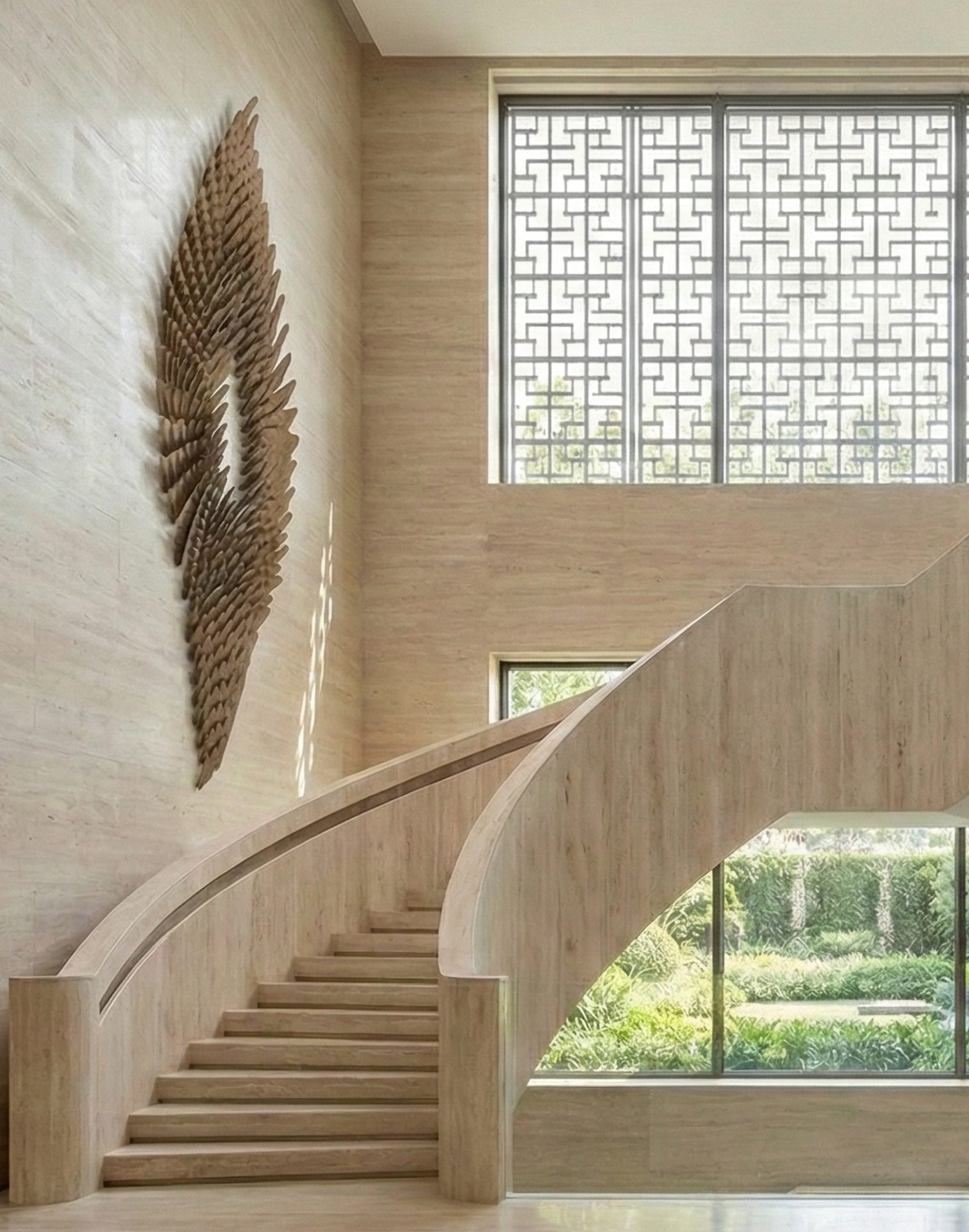
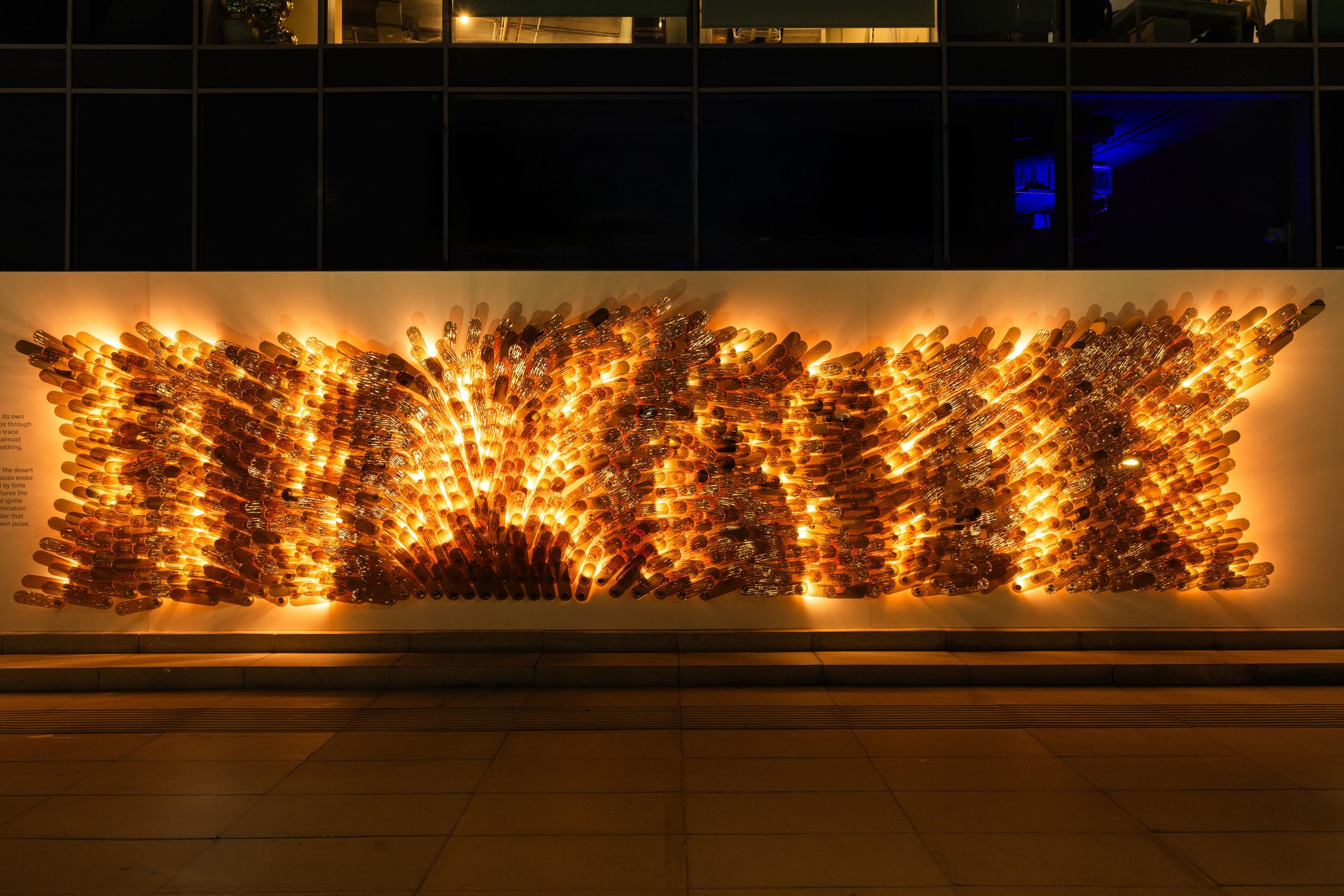
Switch is built from a single glass element, repeated. What changes is how each piece sits — its angle, its spacing, its turn — and that is decided by a field of forces running underneath the surface. The elements never repeat mechanically; they lean and shift as though something invisible were moving through them, the way wind lays a pattern across a field of wheat. That makes it an ecosystem rather than a product: one element, one set of rules, and a composition grown to fit whatever wall or span it has to cover. Square, Maelstrom, Trace and Ridge are published as sample compositions, but they are starting points, not a catalogue.
Switch
A snapshot of an invisible force, caught in glass


Where the name comes from
The name came from the first piece. For Euroluce in Milan in 2025 I built an installation around a single gesture — the slide of a digital switch, the small movement everyone makes a hundred times a day without looking. Held still in glass and multiplied across a wall, that flick became a wave: mirrored surfaces catching the room and handing back a version of it that shifts as you walk. The installation was called Switch, it opened the collection, and the name stayed on everything that came after it.
One system, many snapshots
Because the system generates rather than repeats, every installation since has been its own iteration. Solar Wind, at FIND Design Fair Asia in Singapore, turns the pattern into the movement of an aurora. Soul of the Dune, five metres of aurum-coated glass in Dubai, holds the shape wind leaves in sand. Mandala of Light in Delhi folds it inward; Dahlia After Rain, at WOW!house London, opens it out into petals. The collection has travelled from Milan to Prague, Singapore, Dubai, Delhi and London. Choosing the snapshot that suits the place and the occasion is the part the Sans Souci team and I do together.


What makes the variation buildable
The geometry is generated in Grasshopper, through a plugin I wrote for it; the force field is vector mathematics underneath the poetry. The harder half is making the output producible: every element sits at its own angle, so each one needs its own bracket. Those brackets are 3D-printed, which turns an endless set of angles from a manufacturing problem into a print queue, and some of them carry the lighting inside them. A rule-based system plus printed components is what lets one design language produce a different piece every time without starting over.