Architects once designed buildings, but also machines, clocks and mechanisms. That older, wider job is the one I actually do.
The work runs in one direction: from bits to atoms. A shape starts as logic — a script, a set of rules, a system that generates it. Then it has to become a thing. Panels a workshop can cut. A mechanism that keeps moving in public for months. A product that fits ten thousand different bodies.
Almost everything that goes wrong in a complex project goes wrong in that crossing. The crossing is the job.
A mind that takes things apart
Hearing a problem and seeing a solution is not a discipline. It is a reflex, and it arrived early.
The discipline came later: the habit of turning a creative problem into an analytical one. Not to drain the life out of it — to find the rule underneath it. Most complex shapes are not complicated at all once that rule is found. They are one idea, repeated with variation. Finding the idea is the interesting part. Everything after it is arithmetic, and arithmetic is what machines are for.
The other half of this is less elegant. Curiosity here has no brakes. A problem worth solving gets more attention than it strictly deserves, at hours it deserves even less. Mostly that is a flaw. It is also why the answers are good.
What the hands know
Geometry gets scripted rather than drawn. Robots get programmed directly — KUKA or UR, the dialects differ, the language doesn’t. Printers, mills and lasers are ordinary here. So are motors, drivers and the control electronics behind anything that moves. And wood behaves exactly the way carpentry school said it would.
The point isn’t the list. It’s that one idea can travel across every one of those steps without being handed to someone who will lose half of it in translation. That is rarer than any single skill on it, and it is the whole job.
Where that was learned
Architecture at CTU Prague, then a master’s in Liberec — the first year of it at INHA University in South Korea. A year in Portugal: UMINHO, and six months at the Digital Fabrication Laboratory in Porto with an eight-axis robot. Carpentry at the Crafts Academy in Prague, because a drawing that ignores how wood moves is a picture, not a plan. Two months in Vancouver as lead designer at a company called Tangible Interaction, making public space respond to people — a canopy of three thousand programmable lights over Robson Square, parasols that pour colour down their fins at night, a staircase that sang when you climbed it.
And four missions in Haiti, six weeks each, for Praga-Haiti — a mission drilling water wells. Three of them as the architect of the base being built there; on the fourth, as the head of the mission, drilling. Architecture there comes without the things architecture quietly assumes. No dependable supply of materials. No catalogue. No contractor waiting at the end of the drawing. What arrives is what gets built with, and whoever drew it is standing there when it goes up. That is where designing and making stopped being two jobs. The base is unfinished — the country is not safe to build in at the moment, so the construction waits.
The work that made the noise
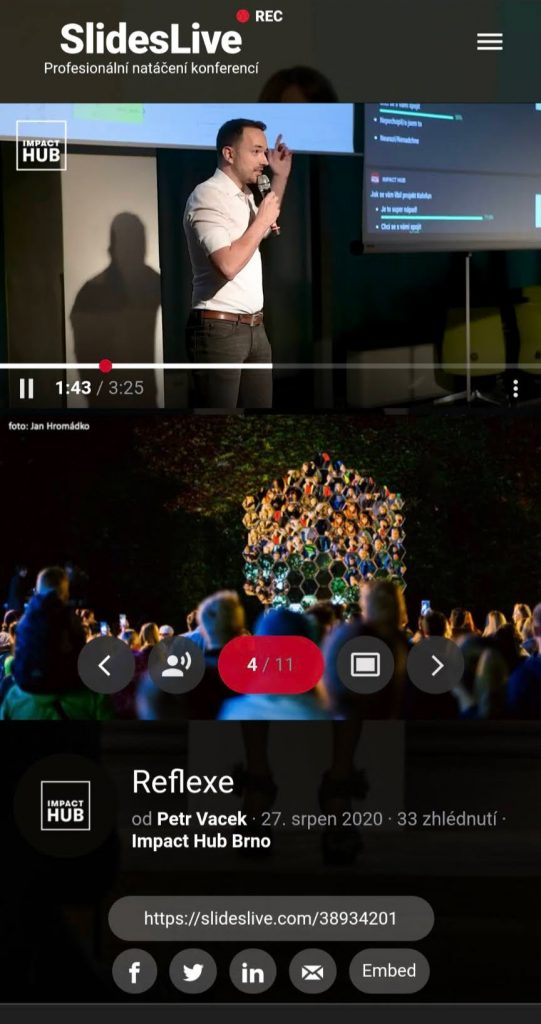
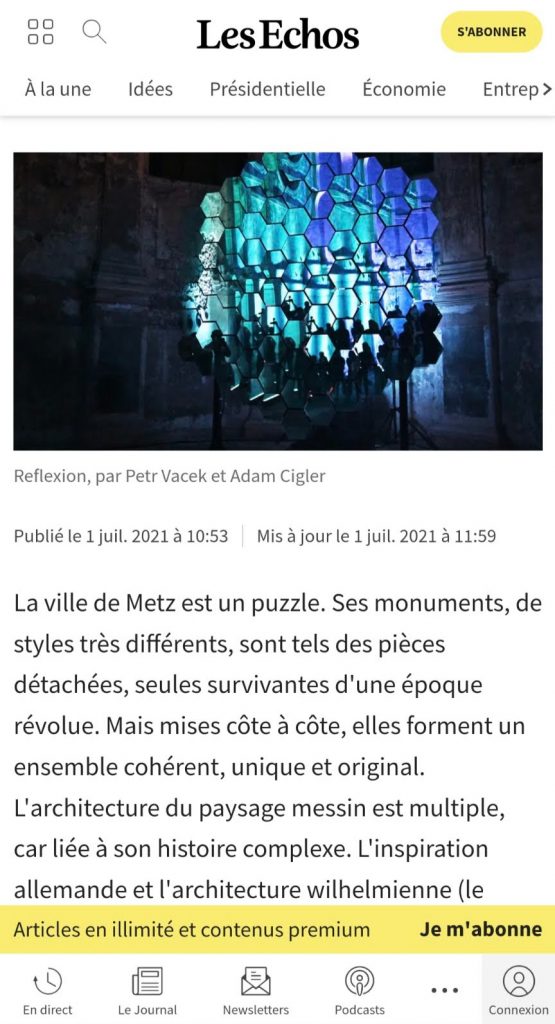
Reflexe — a wall of 91 robotically controlled mirrors, made with Adam Cigler for Signal Festival, which commissioned it through a competition run with Prusa Research. It opened at the Anežský klášter in Prague in 2019 and still tours once or twice a year.
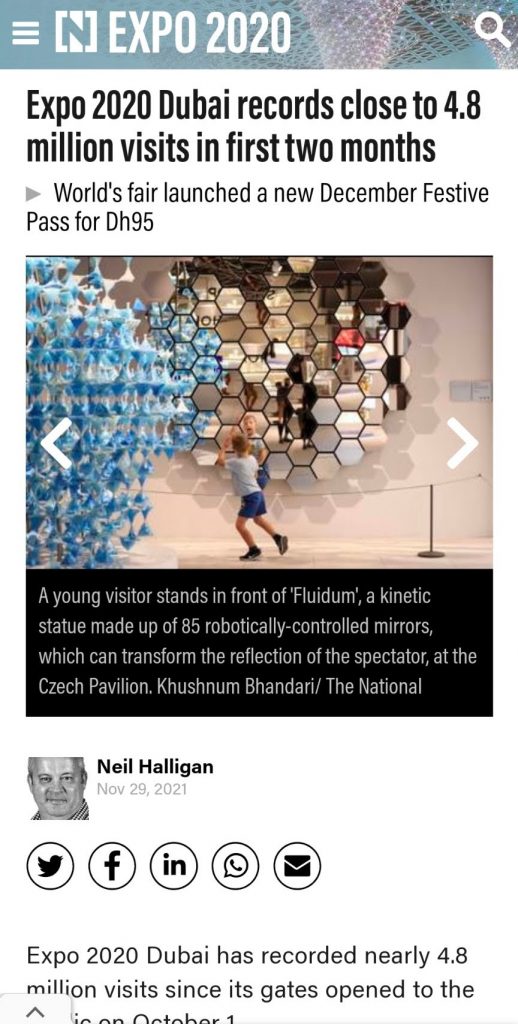
Fluidum — its successor, 85 mirrors, produced by Prusa Research through PrusaLab. It ran at World Expo 2020 in Dubai.
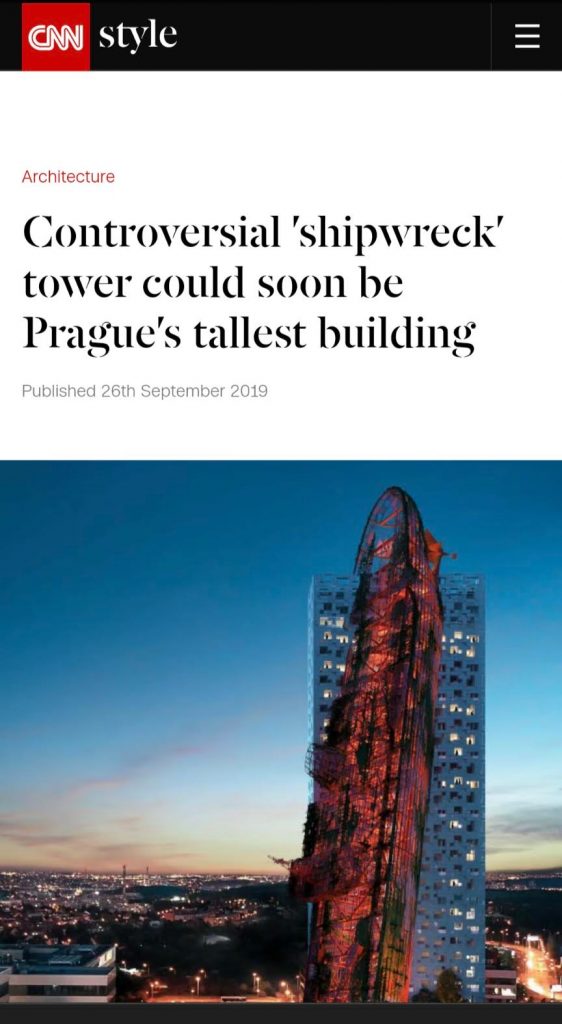
Top Tower — a 135-metre building planned for Prague by developer Trigema, with a ship’s hull leaning against it. Design by David Černý and Tomáš Císař; the geometry of the wreck is scripted rather than drawn. CNN reported on the argument it started.
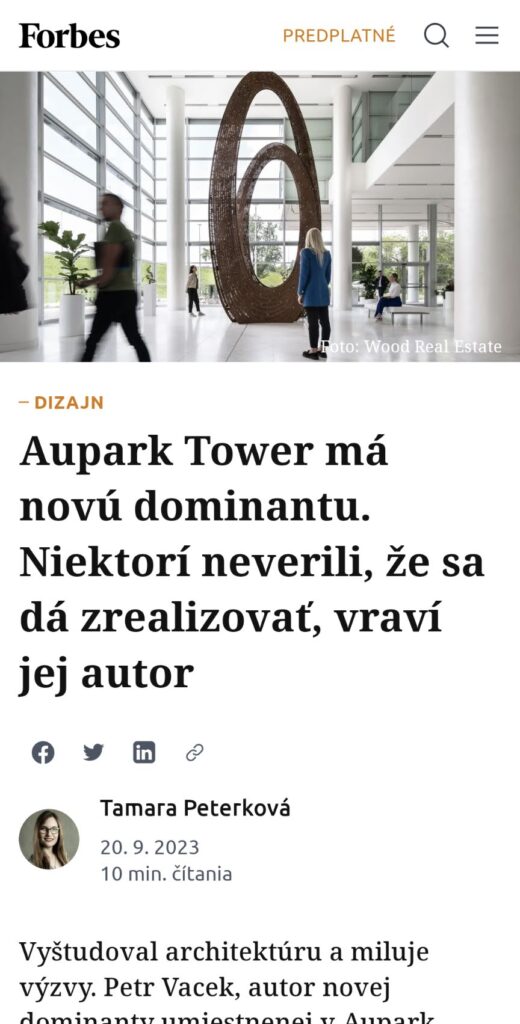
Divnô — a rusted sculpture of two elliptical arches, perforated with verses from a Slovak ballad, standing at Aupark in Bratislava beside the park named after the poet who wrote it. Forbes covered it.
What this is, underneath
The title on the business card says architect. The honest word is maker — someone who would rather find out than be told, and who keeps a workshop for exactly that reason.
None of that is a hobby competing with the work. It is where the work comes from. Every technique that later shows up on a facade or inside a mechanism was learned first on something nobody ordered.